A Working Day on the Arm
World-Model Policy Learning from Few Real-Arm Rollouts
Hebbian Robotics
Research in progress · All results shown are simulation-only
Abstract
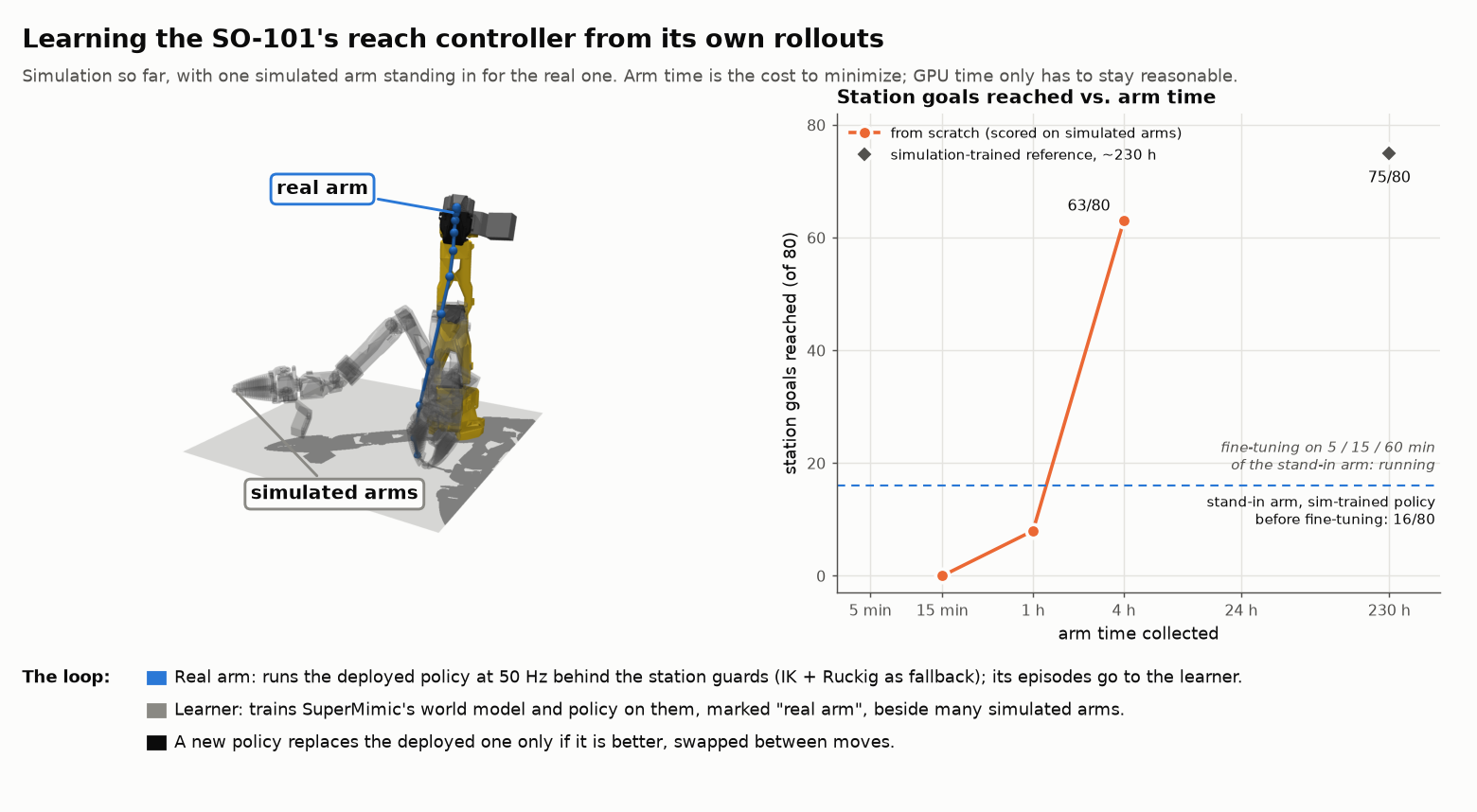
Learning directly on a physical robot is constrained by the time needed to collect rollouts. We study whether SuperMimic, a world-model learner that trains its policy through imagined rollouts, can learn a reaching controller from a practical amount of arm experience. We adapt the official learner to the SO-101 and evaluate it under a controller station's reaching and safety contract. On one fixed simulated arm standing in for a real one, a policy trained from scratch reaches 70–71 of 80 station goals after eight hours of arm time, across two seeds. A soft actor-critic baseline reaches none under the same data budget. These experiments measure data efficiency in simulation; the controller has not yet been tested on hardware.
Learning on one arm
One fixed simulated SO-101 stands in for a physical arm. Episodes start where the previous episode ended, every collected step is retained, and arm time counts the experience collected at 50 Hz. Sixteen simulated copies collect in parallel; a four-copy comparison produced similar results.
SuperMimic goals reached
across two seeds
Median final position error
across two seeds
Goals reached by the
soft actor-critic baseline
The baseline is one standard configuration, not a tuned model-free learner. The simulated arm is a nominal plant, not a hardware-fitted model. The reference learner used roughly 230 hours of experience from randomized simulated arms to reach 75 goals.
Learning through imagination
The world model learns to predict joint motion from collected transitions. The policy then practices through short imagined rollouts and improves by backpropagating through the model. The station's target limits, goal tolerances, and sensor noise shape the training setup; the model also receives targets still in flight behind the servo command delay.
The longer-term goal is to start from a simulation-trained policy and improve it using an individual arm's own rollouts while simulated arms continue training alongside it. That physical-arm learning loop remains future work.
Reaching in the station
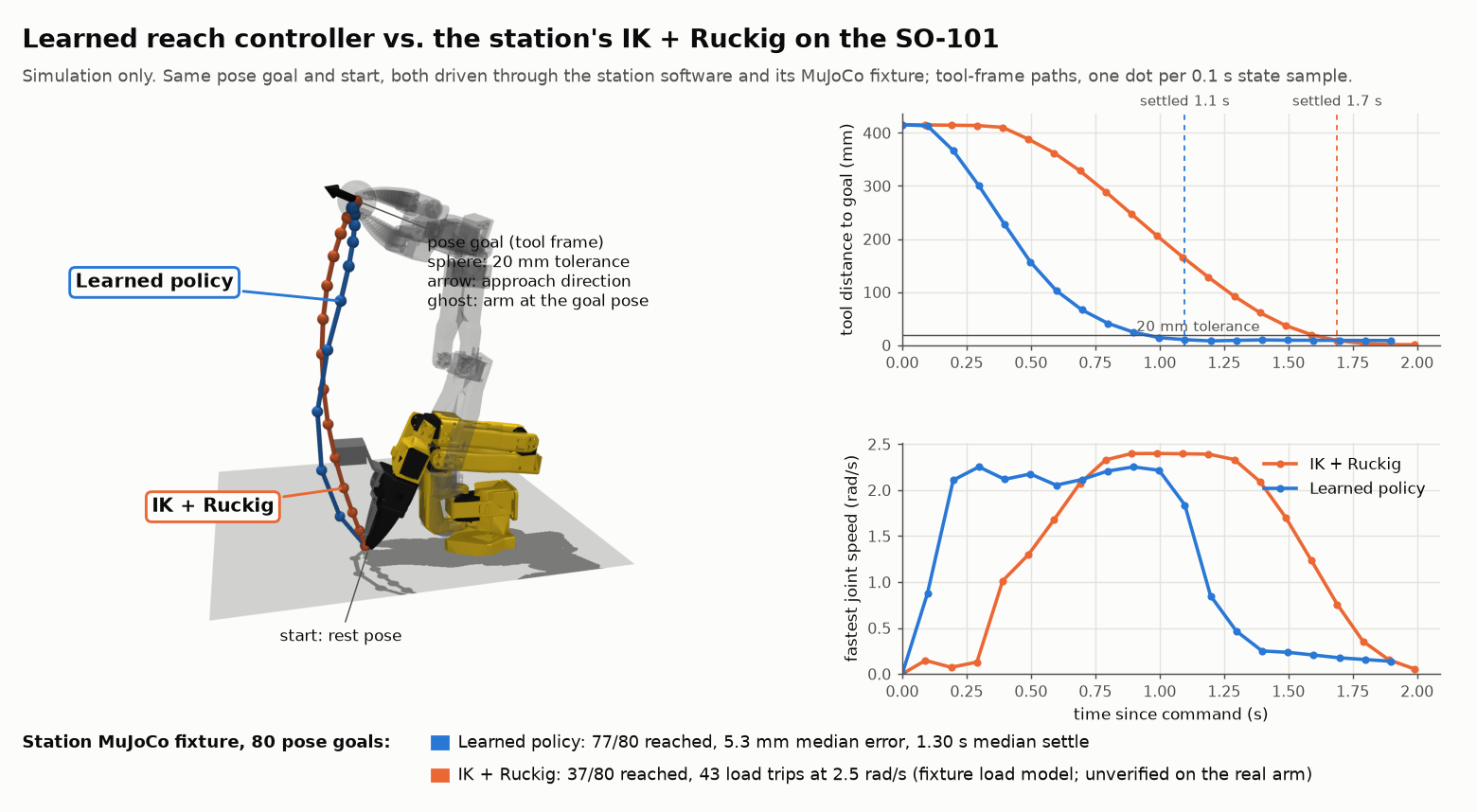
The simulation-trained policy and the station's IK + Ruckig controller are evaluated on the same pose goals in the station's MuJoCo fixture.